
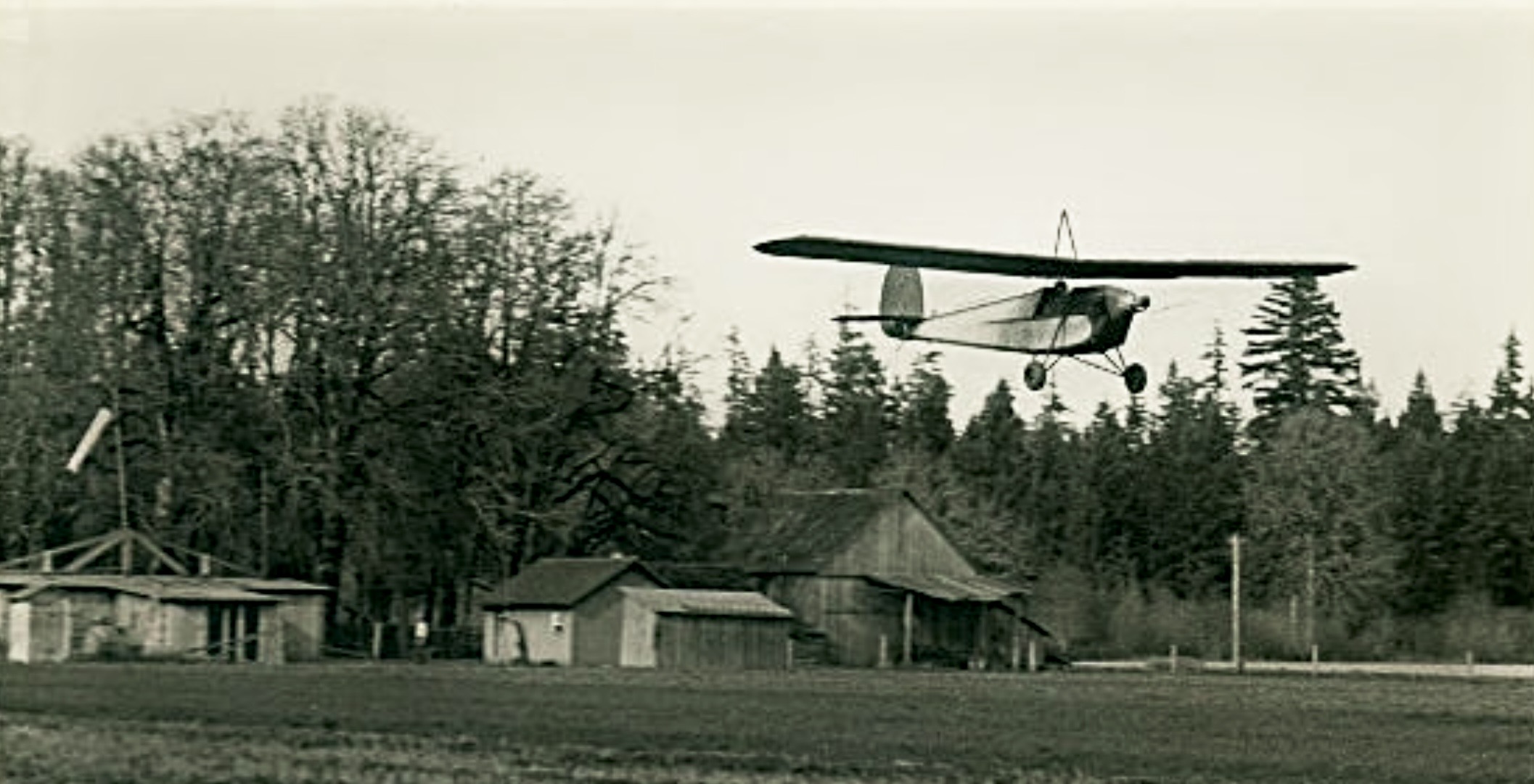
Here in the Pacific Northwest, there has been a unique focus on the recreation of building and flying small aircraft. The following text by historian Chris Riedener outlines Les Long’s involvement and contributions.
Research and text by Chris Riedener December, 2025
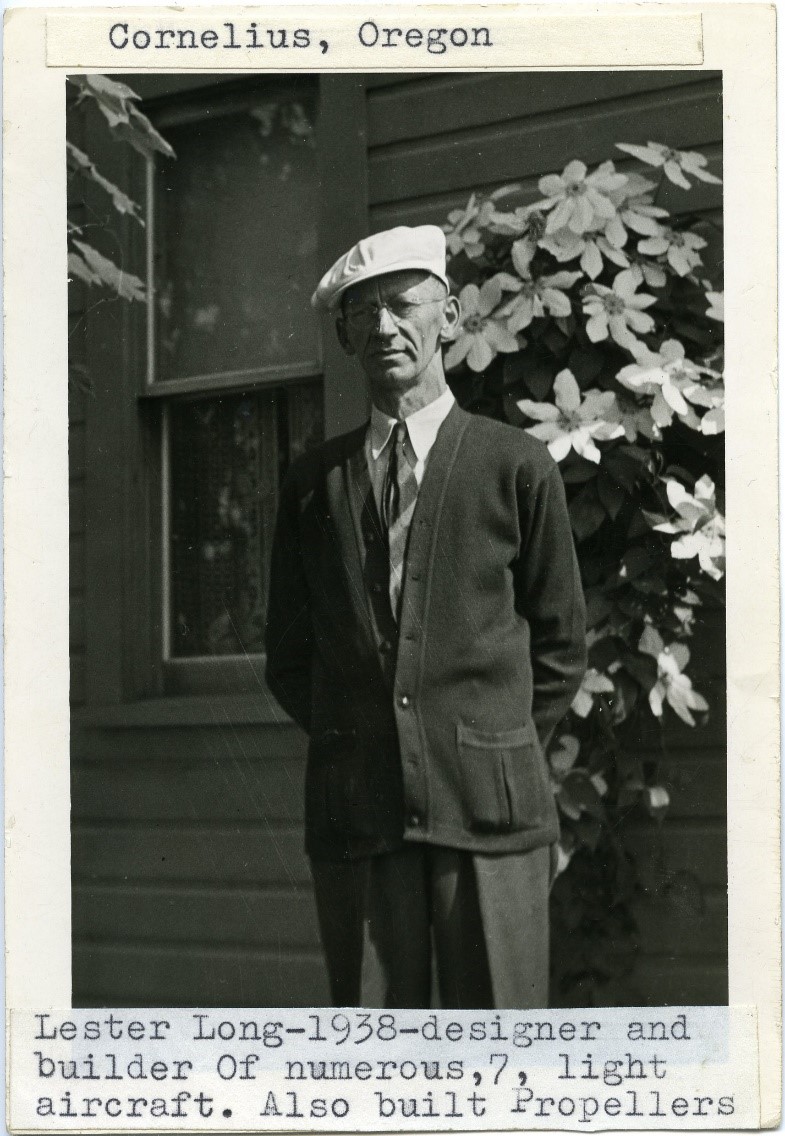
Leslie Leroy Long (about 1891 – Jan. 18, 1945) was an American aircraft designer, builder and advocate for amateur aircraft builders during the 1930s and 1940s.
Throughout the 1930s, as the Department of Commerce began defining the aviation system in the United States,[1] Long argued for a category of aircraft with limited performance that was safe, affordable, and could be built by an amateur. He argued that there should be different requirements for amateur aircraft certification. He favored an amateur pilot’s license.[2] These are some of the tenets that were eventually incorporated into the FAA’s Light Sport Aircraft rules in 2004, and revised by MOSAIC (Modernization of Special Air Worthiness) in 2025.
Les made multiple attempts to rally and/or to organize amateur aircraft builders into a national voice. In 1944 Long cofounded a national organization known as the American Airmen’s Association. The goal of these organizations was to unify likeminded amateur aircraft builders. Today the EAA (Experimental Aviation Association) plays this role and has more than 300,000 members worldwide. The EAA recognized Long in 2000 when he was posthumously inducted into the EAA Homebuilders Hall of Fame.[3]
Long designed seven airplanes, an engine, and hand built wood propellers.[4] A copy of his final design, the Low Wing Longster, named Little Gee Bee, was flown from Oregon to Washington D.C. by George Bogardus in 1947, 1948 and 1951. These demonstration flights, the aircraft’s design, and the collective voices of the American Airmen’s Association helped to persuade the federal government to create the EAB (experimental amateur built) category.[5] Little Gee Bee now resides in the National Air and Space Museum of the Smithsonian Institution.
Life
Long died unexpectedly on Jan. 18, 1945 at his family farm near Cornelius, Oregon.[6] He was about 54 years old. He was married, had a son, a daughter and a step-daughter. His brother George, one of three, was a business partner.[4]
A series of personal letters, written to George Bogardus in 1943-44, just a year before he died, give intimate insights into his health, his sense of humor, his passion for aviation, and the new organization that he and Bogardus were forming.[7]
Les had several occupations including building custom radios[8] and manufacturing an electric fence controller that he’d invented. He hand-built propellers for fruit dryers and later for airplanes. In the mid-1920s he became interested in designing and building amateur aircraft.[9] His initial designs were similar to contemporary amateur aircraft designed by Bernard Pietenpol, Orland Corben, Edward Heath, and Ivan Driggs.
Les wrote for Popular Aviation, Modern Mechanics (known as Modern Mechanix after 1932, and Mechanix Illustrated after 1938), Sportsman Aviation, and others. He made contributions to affordable home-built aircraft, engine and propeller design and construction. He was an advocate of grass roots organization, experimental learning and building.
Long advertised a local air service, from his farm airstrip in Cornelius, in 1935 with Ed Ball as the head pilot.[10] Ball, who had license #5 issued by the Oregon State Board of Aeronautics, used a Salmson powered American Eaglet, a certificated airplane, to give flight instruction. Locals Jerry and Dick VanGrunsven, Phil Duyck and Phil Brown, said Les used his private airstrip to test his various designs,[11] and that Long’s strip was a gathering place for amateur builders and fliers (communication with author, December 2024, and June 2025).[4]
Early photos show Long’s personal logo on the sides of his prototype aircraft – a sort of cruciform with the letters L-O-N-G as the vertical, and propeller blades as the horizontals.[12]
Aircraft Design and Technical Writing
Les wrote numerous magazine articles between 1931 and 1941. He was a recognized voice for amateur aviation.
Initially he contributed his technical ideas about the design and construction of light airplanes[13][14] and he provided details about his own designs. For example the Anzani Longster,[15][16] a mid-wing design, powered by a three cylinder Anzani engine. He followed with the Henderson Longster,[17] and details of an engine that he designed and built, the Harlequin engine.[18]
In 1935 he built and compared high, low/high, and low wing prototype airplanes with both strut and wire bracing. He used the same or similar airframes. The conclusion of this experiment was that a low wing, wire braced design was optimal. This put to rest remaining notions about using biplane, parasol, or strut bracing for low power designs.[19][20] This design became known as the Low-Wing Longster.
Ed Ball and Norman (Swede) Ralston are credited with helping Long to build the second incarnation of his Low-Wing Longster.[21][22] The airplane was eventually called Wimpy.
Les’ final airplane, the third iteration of his Low-Wing Longster design, was improved on by himself and George Bogardus, e.g. by using the new NACA 23012 airfoil.[22] The airframe was built by Tom Story and Lee Eyerly.[23] The airplane was later purchased by George Bogardus, and named Little Gee Bee. George used this airplane to make his three historic flights between Oregon and Washington D.C.[22]
Little Gee Bee and Wimpy, have survived. They reside in the National Air and Space Museum of the Smithsonian Institution, and the Oregon Aviation Historical Society (OAHS) respectively. An Anzani Longster replica built by students at Lane County Community College resides in the OAHS Museum. A Henderson Longster replica built by by Phil Duyck, per the original plans, resides in the Western Antique Aeroplane and Auto Museum (WAAAM).
Between ten and 50 Harlequin engines were built. Several are known to exist. One is on display at the Glen H. Curtiss Museum. The OAHS has one on display. One resides in a private collection in Oregon.
Advocacy
Since 1921 the state of Oregon had a unique set of aviation laws that allowed amateur aviation. Oregon had a board, known as the Oregon state board of aeronautics, which licensed pilots, and aircraft. It also certified aircraft for use within the state.[24]
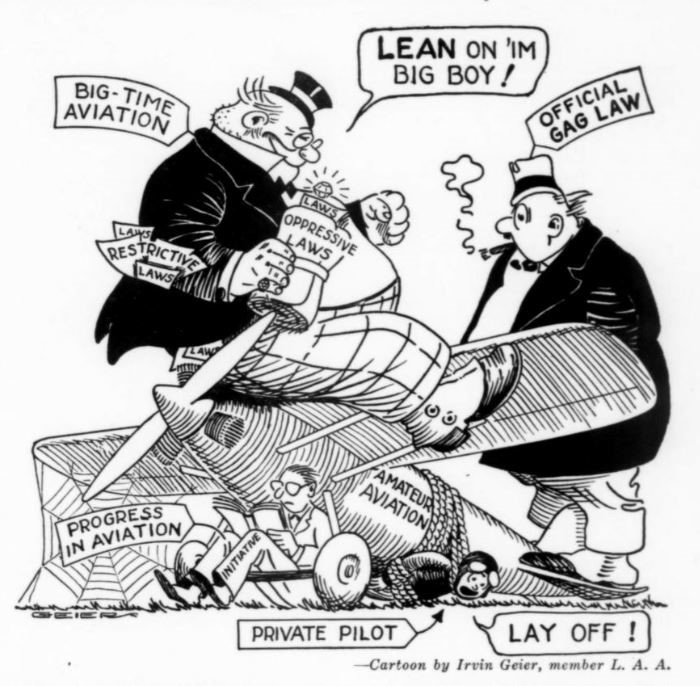
Long was against increasing federalization which which began after 1926 and had excluded amateur builders. The source of these changes was the U.S. Department of Commerce Aeronautics Branch.[25][26]
Les argued: “Amateur flying is not interstate commerce, shouldn’t be regulated as such.” He believed: “We should have an experimental amateur license.” He argued for: a limited medical exam[2], and for non-commercial pilot licensing.[27]
He was against the necessity for stress analysis (part of federal aircraft certification).[2] He suggested an amateur category of aircraft which had engines with limited power and a limited number of passengers (counter arguments for safety concerns).[28]
Les felt that the Federal rules favored “big business.” He frequently argued that the average person (post Great Depression) couldn’t afford a license, training, or the cost of certified aircraft ownership. Besides, amateurs were the future would-be customers, commercial and military pilots.[29]
In 1938 and 1939 Popular Aviation articles Les profiled several individuals in Oregon that exemplified what he thought could be a national model.[20][30] He profiled Charlie Bernard, a Beaverton airstrip owner and advocate,[31] George Yates the geodesic airplane designer/builder,[32] and Allen Greenwood, the Oregon aviation inspector.[33] His point was: Oregon had a functioning system for homebuilders that supplemented the Federal rules. It was supported by businessmen as well as the State’s government.
Les grew increasingly frustrated with the federal situation and eventually despondent. In June 1941 he published one final article in Popular Aviation.[34] He provides a concise history of home building and its contributors, a brief history of government controls. He explains how the individual states capitulated, how the Amateur Aircraft League (AAL) was formed and how it fell. He emphasizes the value of experimentation and having amateur builders/flyers. Finally, he foretells U.S. involvement in WWII and concedes that amateur aviation isn’t a priority at that moment in history. He’s hopeful that: “Maybe someday, when the world returns to normal, things will be different.”
Long’s Amateur Organizations
Long believed amateur builders would succeed through collective action. He refers to the way radio technology evolved in the 1920s and how amateurs might have been sidelined by government regulation.[28][34][35] Instead, they organized into the American Radio Relay League and lobbied for privileges.
Les participated in multiple state and national level organizations that represented the amateur aircraft builder including: the Light Airplane Association in 1933.[36][37][38][39] Membership included John B. Rathbun the Editor of Popular Aviation, and aircraft designers Pietenpol, and Corben. The Amateur Aircraft League in 1934.[2][27][40][4] The Oregon Private Flyers’ Association in 1937.[30] And finally the American Airmen’s Association about 1944.[7] The AAA founders included Les Long, Roy Fry, and George Bogardus.[5]
References
- “A Brief History of the FAA”.
- Long, Leslie (Sep 1934). Proceedings of the A.A.L. (formerly the L.A.A.). Sportsman Aviation. pp. 15, 33.
- “EAA Homebuilders Hall of Fame | EAA”. www.eaa.org.
- Bogardus, George (1945). “Les Long (obituary)” (PDF). Triple A Flyer.
- Taylor, Robert (September 5, 1986). “George Bogardus interview for the Antique Airplane Association”. Document located in the EAA Chapter 105 George Bogardus archive.
- “Leslie L. Long Dies Suddenly”. Hillsboro Argus. January 25, 1945. p. 8.
- Long, Leslie. “EAA Chapter 105 Bogardus Archive”.
- Redman, Art. “Long Radio Works”. www.antiqueradio.com.
- Millman, Loren H. (July 31, 1938). “Worldwide Industry Rises From Modest Oregon Farm”. The Oregonian. p. 4.
- “Longs Expand Service in Air”. Hillsboro Argus. January 17, 1935. p. 1.
- “Leslie Long’s airplane”. washingtoncountyheritage.org.
- “Aircraft N15516 (1937 Ralston SPECIAL C/N 11) Photo by unknown, property of Swede Ralston Archives (Photo ID: AC1017673)”. airport-data.com.
- Long, Leslie (April 1933). Welding and Brazing Methods (1933-04: Vol 12 Iss 4 ed.). Popular Aviation. pp. 237, 238.
- Long, Leslie (January 1933). Elementary Features of Lightplane Design (1933-01: Vol 12 Iss 1 ed.). Popular Aviation. p. 32.
- Long, Les (1931). 1931 Flying And Glider Manual [How To Build the Longster]. Modern Mechanics And Inventions. pp. 9–15.
- “First Plane Built in County is Success Les Long, Cornelius Radio Man, Designer”. Hillsboro Argus. October 17, 1929. p. 1.
- Long, Leslie (1933). 1933 Flying And Glider Manual [Henderson Longster]. Modern Mechanics and Inventions. pp. 48–57.
- Long, Les (1933). 1933 Flying And Glider Manual [The Long Harlequin Motor]. Modern Mechanics And Inventions. pp. 58–68.
- Long, Leslie (November 1935). Some Remarkable Experiments In Lightplane Performance (1935-11: Vol 11 Iss 5 ed.). Popular Aviation. pp. 280, 281, 330.
- Long, Leslie (June 1937). Some Practical Notes on the Construction of Low-Wings (1937-06: Vol 20 Iss 6 ed.). Popular Aviation. pp. 32–34, 59.
- Buswell, Myron (February 1988). “Les Long’s Wimpy”. EAA Experimenter: 18–19.
- Bogardus, George (March 12, 1988). “Little Gee Bee”. EAA Experimenter: 12–13.
- NX31250 (Little Gee Bee) Aircraft Airframe Logbook. Document located in the EAA Chapter 105 George Bogardus archive.
- Oregon laws governing aeronautics: compiled to January 1, 1944. Portland, Ore: Office of State Board of Aeronautics. January 1, 1944.
- Fowler, A.C. (Jan 1933). Howl Department for Amateurs (1933-01: Vol 12 Iss 1 ed.). Popular Aviation. pp. 24, 46.
- Long, Leslie (May 1933). Let’s Start the Big Push (1933-05: Vol 12 Iss 5 ed.). Popular Aviation. p. 301.
- Long, Leslie (Oct 1934). Proceedings of the A.A.L. (formerly the L.A.A.). Sportsman Aviation. pp. 15, 32.
- Long, Leslie (1933). L.A.A. Chairman Airs Views. Popular Aviation. pp. 365, 366.
- Long, Leslie (Feb 1934). Comments on the New Deal (1934-02: Vol 14 Iss 2 ed.). Popular Aviation. pp. 99, 132.
- Long, Leslie (July 1937). Why Keep Restricting Amateurs? (1937-07: Vol 21 Iss 1 ed.). Popular Aviation. pp. 39, 40, 71.
- Long, Leslie (Nov 1938). Pilots’ Godfather (1938-11: Vol 23 Iss 5 ed.). Popular Aviation. pp. 30, 31, 82.
- Long, Leslie (July 1938). Oregon’s Lightplane Patriot (1938-07: Vol 23 Iss 1 ed.). Popular Aviation. pp. 57, 58, 76.
- Long, Leslie (April 1939). Rugged Individual. Popular Aviation. pp. 43, 72, 74.
- Long, Leslie (June 1941). The Home Builder Bows Out (1941-06: Vol 28 Iss 6 ed.). Popular Aviation. pp. 27, 28, 80.
- Rathbun, John B. (July 1933). Talking Turkey With the L.A.A. Internet Archive (1933-07: Vol 13 Iss 1 ed.). Popular Aviation. pp. 25, 26.
- Long, Leslie (April 1933). Progress Made In L.A.A. Drive (1933-04: Vol 12 Iss 4 ed.). Popular Aviation. pp. 233, 234.
- Rathbun, John (April 1933). An Airy Chat With the Editor (1933-04: Vol 12 Iss 4 ed.). Popular Aviation. pp. 210, 269.
- Kramer, Frank (Feb 1933). Howl Department for Amateurs (1933-02: Vol 12 Iss 2 ed.). Popular Aviation. p. 85.
- Corben, Ogden G. (Aug 1933). Last Call for L.A.A. Members (1933-08: Vol 13 Iss 2 ed.). Popular Aviation.
- Long, Leslie (Nov 1934). Proceedings of the A.A.L. (formerly the L.A.A.). Sportsman Aviation. pp. 15, 30.
Further reading
- George A. Hardie Jr (December 1987). “Henderson Longster”. EAA Experimenter. pp. 31–34.
- George A. Hardie Jr (January 1988). “The Low Wing Longster”. EAA Experimenter. pp. 28–29.
- Les Long. Vol. 1. Oregon Aviation Historical Society Newsletter. March 2011. p. 4.
External links
EAA Chapter 105 George Bogardus Archive
Photo of parasol Longster (pilot Bruce Haverstick)
Henderson Longster replica WAAAM
Oregon Laws Governing Aeronautics 1921-1944
Photo of Low-wing Longster AKA “[Swede Ralston Special”] AKA Wimpy
Photo of Low-wing Longster Wimpy with Les Long’s emblem on the fuselage

Photo of the Ball-Ralston Flying Service hangar at Hillsboro Airport
Phil Brown’s historical photos of Hillsboro aviation